Try a free demo lesson

How to Get 100% in Ionic Equations | GCSE & IGCSE Chemistry Tips
Learn how to master ionic equations with simple steps, worked examples, exam tips, and common mistakes. Perfect for GCSE, IGCSE, and A-Level Chemistry students aiming for top grades.
Shumaila Kanwal
7/25/20262 min read
How to Get 100% in Ionic Equations
If ionic equations make you nervous, you're not alone. Thousands of GCSE, IGCSE, and A-Level Chemistry students lose easy marks because they don't understand which ions to include and which to cancel.
The good news?
Ionic equations are one of the easiest topics to master once you know the method.
In this guide, you'll learn exactly how to write ionic equations like an examiner expects, avoid common mistakes, and maximise your marks in Chemistry exams.
What Is an Ionic Equation?
An ionic equation only shows the particles that actually take part in a chemical reaction.
It removes the ions that do not change during the reaction. These unchanged ions are called spectator ions.
Instead of writing the complete reaction, we simplify it to show only the essential chemistry.
Step-by-Step Method to Write Ionic Equations
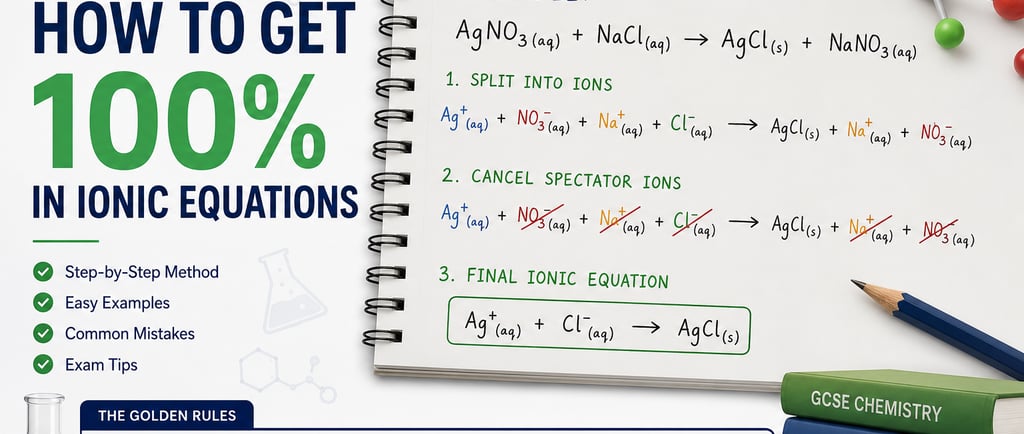
Step 1: Write the Balanced Chemical Equation
Example:
AgNO₃(aq) + NaCl(aq) → AgCl(s) + NaNO₃(aq)
Always begin with the balanced equation.
Step 2: Split Aqueous Compounds into Ions
Compounds dissolved in water separate into ions.
AgNO₃(aq)
↓
Ag⁺(aq) + NO₃⁻(aq)
NaCl(aq)
↓
Na⁺(aq) + Cl⁻(aq)
NaNO₃(aq)
↓
Na⁺(aq) + NO₃⁻(aq)
Do not split:
Solids
Liquids
Gases
Water
Step 3: Cancel Spectator Ions
Both sides contain:
Na⁺
NO₃⁻
These ions remain unchanged, so they are cancelled.
Step 4: Write the Final Ionic Equation
Ag⁺(aq) + Cl⁻(aq) → AgCl(s)
That's it!
Example 2
Hydrochloric acid reacts with sodium hydroxide.
Complete equation:
HCl(aq) + NaOH(aq) → NaCl(aq) + H₂O(l)
Split into ions:
H⁺ + Cl⁻ + Na⁺ + OH⁻
↓
Na⁺ + Cl⁻ + H₂O
Cancel:
Na⁺
Cl⁻
Final ionic equation:
H⁺(aq) + OH⁻(aq) → H₂O(l)
This is one of the most common ionic equations in GCSE and IGCSE Chemistry.
Example 3
Copper sulfate reacts with sodium hydroxide.
Balanced equation:
CuSO₄(aq) + 2NaOH(aq) → Cu(OH)₂(s) + Na₂SO₄(aq)
Split:
Cu²⁺ + SO₄²⁻ + 2Na⁺ + 2OH⁻
↓
Cu(OH)₂ + 2Na⁺ + SO₄²⁻
Cancel:
SO₄²⁻
2Na⁺
Final ionic equation:
Cu²⁺(aq) + 2OH⁻(aq) → Cu(OH)₂(s)
The Golden Rules
Always remember these five rules:
✅ Balance the equation first.
✅ Only split aqueous compounds.
✅ Never split solids.
✅ Never split liquids.
✅ Cancel spectator ions carefully.
Common Mistakes Students Make
1. Splitting Solids
Incorrect:
AgCl → Ag⁺ + Cl⁻
Correct:
AgCl(s)
remains as a solid.
2. Forgetting Charges
Incorrect:
Cu + OH
Correct:
Cu²⁺ + 2OH⁻
Charges matter.
3. Forgetting Coefficients
Incorrect:
OH⁻
Correct:
2OH⁻
Always check balancing.
4. Cancelling the Wrong Ions
Only cancel ions that appear unchanged on both sides.
Examiner Tips for Full Marks
Examiners often award marks for:
Correct charges
Correct state symbols
Balanced atoms
Balanced charges
Correct spectator ion removal
Missing even one of these can cost marks.
Best Way to Practise Ionic Equations
To become confident:
Practise one ionic equation every day.
Memorise common ions.
Learn solubility rules.
Check that both atoms and charges balance.
Mark your own answers using past papers.
Within a week, you'll notice a huge improvement.
Frequently Asked Questions
Are ionic equations difficult?
No. Once you understand spectator ions and know which compounds dissociate, ionic equations become one of the easiest scoring topics in Chemistry.
Do I split all compounds into ions?
No. Only compounds in the aqueous state (aq) are split into ions.
Why are ionic equations important?
They show the actual chemical change taking place and are commonly tested in GCSE, IGCSE, O-Level, and A-Level Chemistry exams.
Final Thoughts
Scoring 100% in ionic equations isn't about memorising dozens of reactions—it's about following the correct method every time. Balance the equation, split only aqueous compounds into ions, remove spectator ions, and check that both atoms and charges are balanced.
With regular practice, ionic equations can become one of the easiest sections of your Chemistry exam.
If you're preparing for GCSE, IGCSE, O-Level, or A-Level Chemistry and want expert guidance, Exceled Academy offers one-to-one online tuition, exam-focused practice, and personalised support to help you achieve top grades.